

Master Your Travel with a Residence Time Calculator
A residence time calculator is an essential tool for tracking the days you spend in different countries, crucial for complying with visa rules like the Schengen 90/180 rule and navigating tax residency laws. Manually tracking this, especially with a 'rolling' 180-day window, is prone to errors that can lead to fines, entry bans, or unexpected tax bills. The simplest way to handle this is by automating the process. The DaysAround iOS app automatically builds a secure, on-device travel timeline from your photos, acting as a private country counter to ensure you are always compliant without compromising your data.
Your Guide to Effortless Residence Time Tracking
Understanding your residence time is key to protecting your freedom to travel and live abroad without legal or financial trouble. For digital nomads, business travelers, and expats, accurate day counting is non-negotiable. The primary challenge is accuracy, especially with complex rules involving rolling periods that change daily. This guide will show you how to achieve precise calculations and avoid common pitfalls using modern, privacy-focused tools.
Why Manual Tracking Fails
Relying on memory or spreadsheets to track your travel days is a significant risk. Human error is common, and forgetting a short trip or mixing up dates can have serious consequences, particularly with rules like the Schengen Zone's 90/180-day limit, where the calculation window is constantly shifting.
Key risks of manual tracking include:
- Forgetting entry/exit days: Most authorities, including the Schengen Area, count both arrival and departure days as full days.
- Miscalculating rolling windows: Manually looking back exactly 180 days from today is tedious and error-prone.
- Losing your records: Paper notes can be lost, and digital files can be deleted or stored insecurely, leaving you without proof of your travel history.
How DaysAround Can Help: The Automated, Private Solution
An automated residence time calculator eliminates guesswork and provides a reliable, verifiable record. The DaysAround iOS app champions a privacy-first philosophy by using your photo library to build your travel history. This method creates a complete timeline and a countries visited map without ever tracking your live GPS location or sending data to the cloud. For quick checks, the free Schengen Zone Calculator is a great resource, but for continuous, automatic tracking, the full app provides unparalleled peace of mind.
By automating your travel history, you shift your focus from tedious counting to confidently planning your next adventure, knowing your compliance is handled accurately and privately.
Manual Spreadsheets vs Automated Tracking
When tracking your days abroad, you have two main options: do it yourself or use technology. Here’s how they compare.
| Tracking Method | Accuracy & Effort | Privacy & Security |
|---|---|---|
| Manual (Spreadsheets/Notes) | High effort, prone to human error, and a real headache for calculating rolling windows. | Depends entirely on how and where you store the file. A document on a cloud drive could be vulnerable. |
| DaysAround App | Automated and precise. It effortlessly handles complex rules like the Schengen 90/180 calculation. | Maximum privacy. All your travel data is processed and stored only on your device. Nothing goes to the cloud. |
Mastering the Schengen Zone 90/180 Day Rule
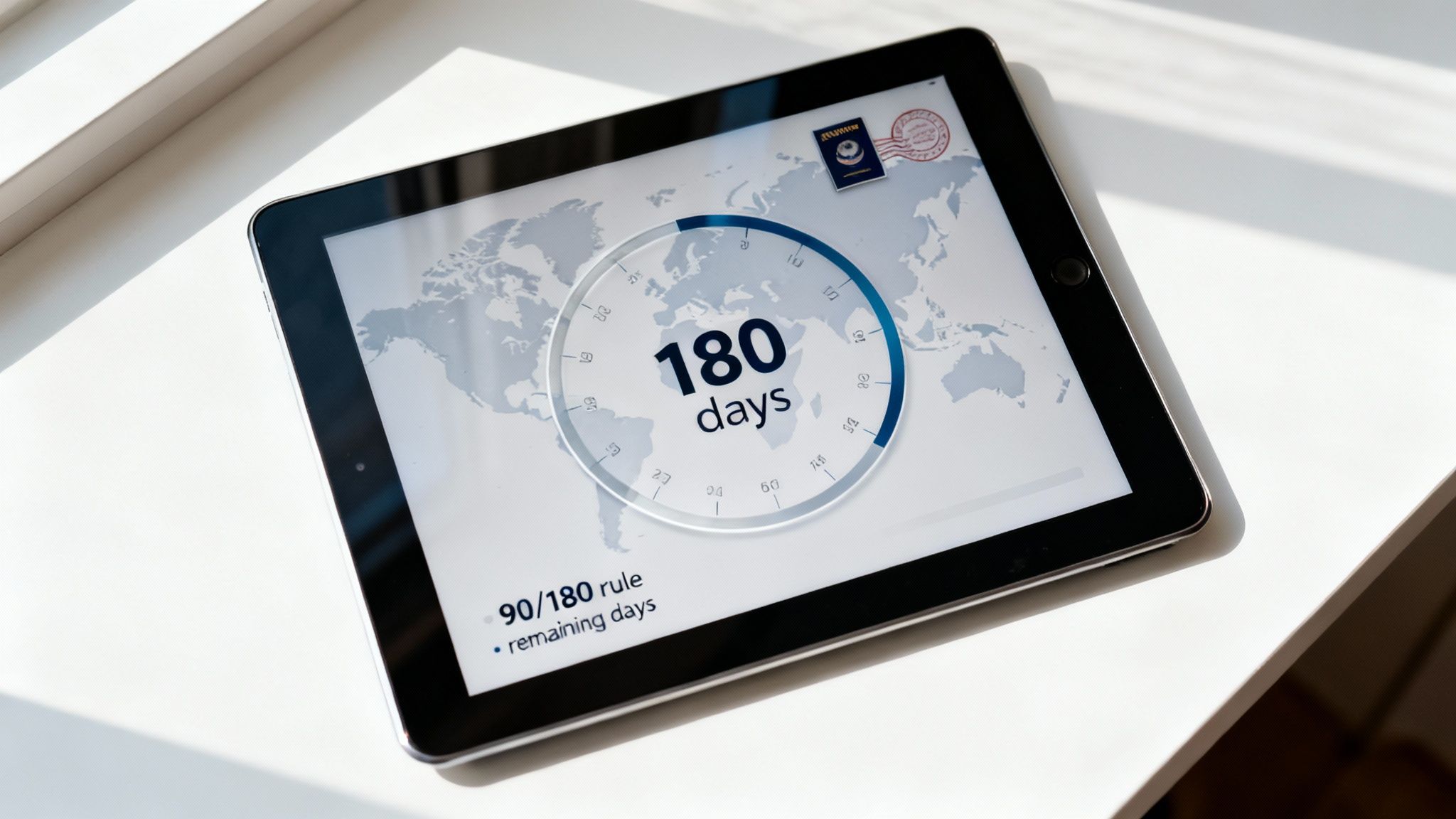
The Schengen Area’s 90/180-day rule is a primary reason travelers seek a residence time calculator. The rule allows non-EU citizens to stay for up to 90 days within any 180-day period across 29 member countries. The "rolling" nature of the rule is what causes confusion. The 180-day window is not a fixed block; it constantly moves. To check compliance today, you must look back exactly 180 days from now and count every day spent inside the zone. This constant recalculation makes manual tracking a significant burden.
The Real-World Impact of Miscalculation
Miscalculation is a common issue. Last year, over 1.2 million travelers were caught overstaying. European Commission statistics show that French authorities denied entry to 127,000 non-EU citizens for exceeding their limit, while Germany's Federal Police recorded 85,000 violations, with fines averaging €500 to €3,000, plus potential entry bans. For more context on trends influencing travel, see this research on national housing forecasts on realtor.com.
How to Calculate Your Remaining Days Accurately
The official method is to look back 180 days from any given date and sum the days spent in the Schengen Zone.
Here's a practical example:
- Today's Date: October 1st.
- 180-day window: April 4th to October 1st.
- Travel History: 30 days in Spain (May), 30 days in Italy (July), 15 days in Germany (September).
- Total Days Used: 30 + 30 + 15 = 75 days.
- Remaining Days: 90 - 75 = 15 days.
Any time spent in the Schengen Area before April 4th is now irrelevant for today's calculation. This constant need to re-evaluate is why a dedicated Schengen calculator is essential.
How DaysAround Can Help: Automated Solution for Total Peace of Mind
While a manual calculator like our free Schengen Zone Calculator is great for planning, it relies on perfect memory or records. The main DaysAround iOS app offers a fully automated, privacy-first solution. Instead of manual entry, the app privately scans your device’s photo library to build your travel timeline.
- It automatically determines which countries you visited and for how long.
- It functions as a personal country counter and countries visited tracker.
- It applies the 90/180-day rule to this accurate, auto-generated history.
This eliminates the risk of human error, giving you a visual timeline and a precise day count without sharing your location or uploading personal data.
Keeping an Eye on the Clock for Tax Residency

Beyond visa rules, tax obligations are equally critical. A residence time calculator is essential for managing tax residency, as many authorities use a day count to determine your status. The most common threshold is 183 days; spending more than this in a single year in a country can make you a tax resident, liable for taxes on your worldwide income. This standard is used by countries like the UK, Spain, and Canada, making precise tracking vital for mobile individuals.
Understanding the Different Tax Residency Tests
Countries use various tests to determine tax residency. Knowing which rules apply to you is the first step in avoiding unexpected tax liabilities.
- The 183-Day Rule: A straightforward tally of days physically present in a country during its fiscal year.
- Substantial Presence Test (USA): A complex formula looking back over three years, counting all days in the current year, one-third of days in the previous year, and one-sixth from two years prior. A total of 183 can trigger tax residency.
- Statutory Residence Test (UK): A multi-layered test considering not just days spent but also factors like home, work, or family ties in the country.
How DaysAround Can Help: A Private Tax Residency Tracker
When managing finances and travel, privacy is paramount. The DaysAround iOS app functions as a private tax residency tracker on your phone. All travel data is processed and stored locally, allowing you to build an airtight travel history without uploading sensitive information. It acts as a precise days per country tracker, giving you the solid numbers needed to check your status against any residency test. You can even export your travel history to support tax filings or applications for documents like a Tax Residency Certificate UAE.
The goal isn't just to track days—it's to maintain control over your financial destiny. An accurate, private record of your travel history is your best defense against accidental tax residency.
How to Build and Verify Your Travel History
A residence time calculator is only as good as the data you provide. A complete and verifiable travel history is essential for accurate calculations that stand up to scrutiny from visa or tax authorities. This involves compiling scattered records like passport stamps, e-tickets, and credit card statements into a single, chronological log—a time-consuming and error-prone process when done manually.
Gathering Your Primary Travel Records
Start by collecting the official "hard evidence" of your travels, which forms the backbone of your log.
- Passport Stamps: Log each entry and exit stamp, noting dates and countries.
- Travel Confirmations: Search your email for flight, train, and bus confirmations to get precise dates and routes.
- Visa Documents: Official start and end dates on visas define your legal stay periods.
For a faster, less error-prone method, see our guide on how to set up a private travel history log in 5 minutes.
Using Secondary Sources for Verification
When primary records are missing or unreadable, secondary sources help fill in the gaps and validate your timeline.
- Credit Card and Bank Statements: A transaction from a café in Paris or a hotel in Tokyo provides solid proof of your location.
- Photo Geotags: Location data embedded in your smartphone photos is a powerful, personal record of your movements.
- Social Media Check-ins: Dated posts can serve as useful personal reminders to pinpoint specific days.
How DaysAround Can Help: The Automated Approach
Manually piecing this puzzle together is a massive task. The DaysAround iOS app automates this process, acting as a countries visited tracker that does the heavy lifting. The app privately scans your photo library on your device, identifying the date and country for each photo to automatically build a secure timeline and a visual countries visited map. This saves countless hours and creates a verifiable, private record you can cross-check against official documents, ensuring your day count is airtight.
Common Pitfalls in Calculating Residence Time
Using a residence time calculator may seem straightforward, but small oversights can lead to major issues. Even meticulous travelers can make common mistakes. For example, forgetting that both the day you arrive and the day you leave count as full days is a frequent error. A weekend trip from Saturday to Sunday counts as two days, not one, quickly depleting your allowance.
Another common mistake is confusing different visa zones. While a trip to the non-Schengen UK doesn't count towards the 90-day limit, uncertainty about which Balkan countries are in the zone can throw off your entire calculation.
The Tricky "Rolling" 180-Day Window
The "rolling" nature of the Schengen 90/180 rule is where most people get into trouble. The 180-day window is a live, constantly shifting period that looks backward from today. Each day, the window moves forward, dropping the oldest day from your count. Tracking this manually is highly unreliable. Data suggests that 41% of digital nomads struggle with rolling calculations, leading to visa problems. For more context on global travel trends, you can review these insights on demographic shifts on apapolloacademy.com.
The biggest mistake you can make is treating the 180-day window as a static block of time. It’s a live calculation that changes every single day, which is precisely why tracking it by hand is so unreliable.
How DaysAround Can Help: Avoid These Mistakes
The DaysAround iOS app was designed to eliminate these common and costly mistakes by automating the process and removing the risk of human error. It privately builds your travel history from your phone's photo library.
- Flawless Day Counting: As your personal countries visited tracker, it accurately logs every day in every country, including entry and exit days.
- Masters Complex Rules: It perfectly handles the tricky rolling 180-day Schengen window, providing an accurate, up-to-the-minute count of your remaining days. For quick planning, you can also use our free Schengen Zone Calculator on the web.
- A Clear Visual Timeline: It presents your travel history on an easy-to-read timeline, helping you spot potential issues long before they become problems.
DaysAround simplifies a complex, high-stakes calculation into a simple, visual check, allowing you to focus on your trip instead of the math.
Frequently Asked Questions (FAQ)
What's the best way to track my days for the Schengen rule?
The most reliable method is using an automated tool. While our free Schengen Zone Calculator is great for quick planning, the DaysAround iOS app offers a complete, set-and-forget solution. It automatically builds your travel history from your photo library, accurately managing the rolling 180-day window without manual data entry.
Do my arrival and departure days both count?
Yes, for the Schengen 90/180 rule and most other visa regulations, both arrival and departure days are counted as full days. An automated countries visited tracker like DaysAround accounts for this automatically, preventing this common overstay mistake.
How can I prove my travel history to an official?
Passport stamps and flight records are your primary proof. However, a detailed personal log is invaluable when stamps are missing or unreadable. With the DaysAround app, you can export a full report of your days per country, which serves as a credible personal record built from your own photos and stored only on your device.
Can a calculator help me with a digital nomad visa?
Yes, it is essential. Many digital nomad visas have specific physical presence requirements, such as a minimum number of days in the country or a maximum number of days allowed outside. A residence time calculator like DaysAround provides a precise, real-time record to ensure you meet these requirements when it's time to renew your visa.
Are online calculators safe to use?
It depends. Many web-based calculators require you to enter travel dates on their servers, which can be a privacy risk. A safer approach is an app like DaysAround, which performs all calculations on your device. Your travel timeline and country counter data never leave your phone, ensuring the highest level of security.
How can an app track my travels without using GPS?
DaysAround uses a privacy-first method. It reads the existing location and time metadata already embedded in the photos on your phone to reconstruct your past travels. This means it only knows where you’ve been, without ever needing to know where you are now, making it a truly secure travel history app.
Ready to take control of your travel history with complete privacy? DaysAround builds a secure, on-device timeline of your travels, acting as your personal country counter and Schengen 90/180 tracker without ever needing your GPS or cloud data. Download the DaysAround iOS app today and travel with confidence.
Sources
- European Commission. (2023). Schengen Area Statistics Report.
- OECD. (2024). Model Tax Convention on Income and on Capital.
- United States Internal Revenue Service. (2024). Publication 519, U.S. Tax Guide for Aliens.