

Your Essential Guide to Using a Visa Calculator Schengen
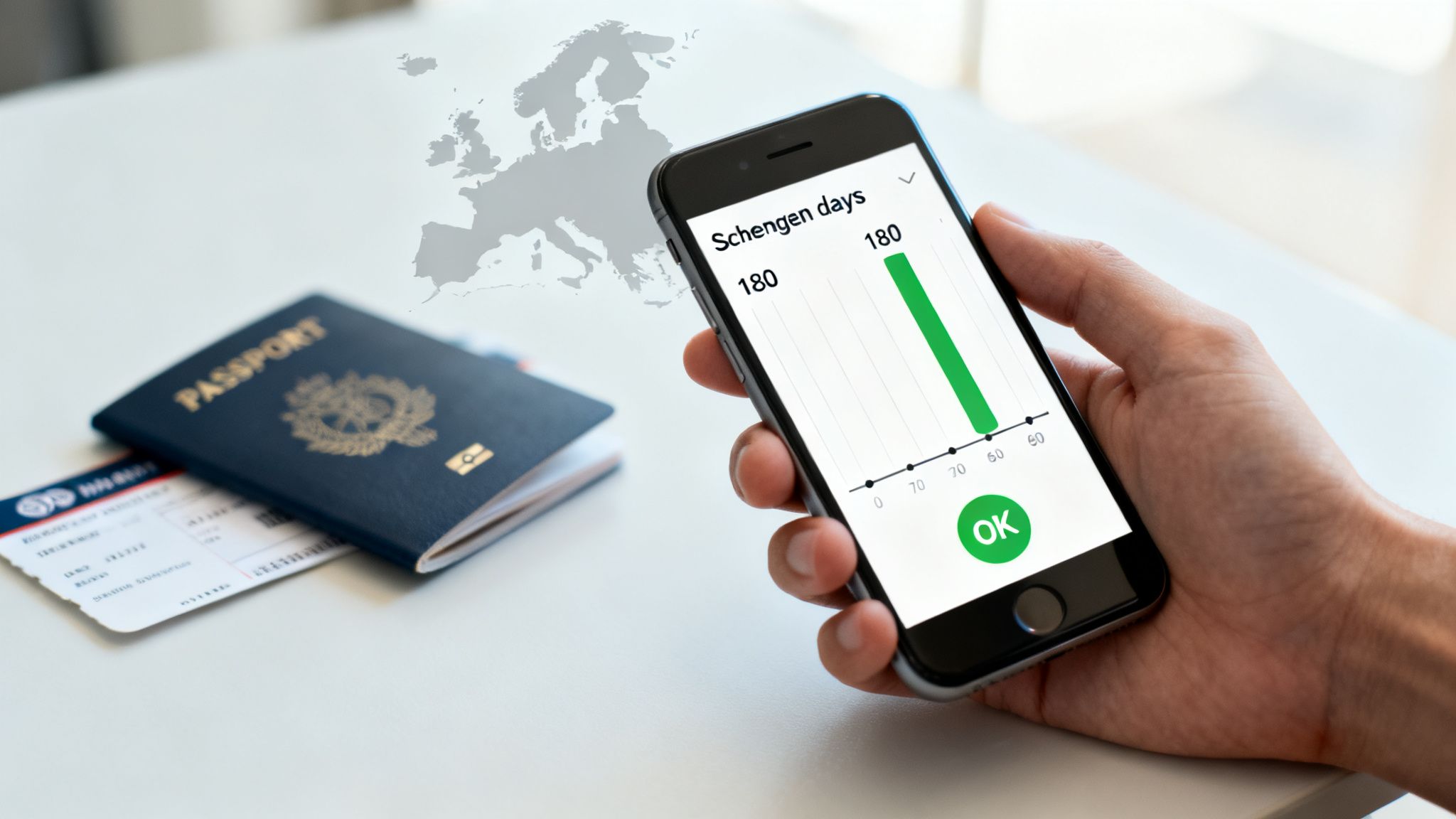
Navigating the Schengen Area's 90/180-day rule can be complex, but a visa calculator makes it simple. The rule allows a stay of 90 days within any 180-day period, and miscalculating can lead to fines or travel bans. The easiest way to stay compliant is by using a dedicated tool that removes the guesswork. For a quick check, the free Schengen Zone Calculator is perfect. For continuous, automatic tracking, the DaysAround iOS App builds a private travel timeline from your photos, ensuring you always know your status.
Take the Headache Out of the Schengen 90/180 Rule
The ability to hop between 29 European countries without flashing your passport at every border is an incredible privilege. It's what makes a European adventure so seamless. But this freedom hinges on one critical regulation: the 90/180-day rule. It’s crucial to remember that this isn't 90 days for each country. It’s a running total for the entire Schengen zone, and that’s where people often get tripped up.
One small mistake—forgetting that weekend trip to Brussels or miscounting a few days in Lisbon—can have big consequences. Overstaying your welcome, even by a day, can lead to fines, deportation, or an entry ban that could derail your travel plans for years. For digital nomads, long-term travelers, or families on an extended European vacation, getting this count right isn't just a suggestion; it's essential.
Why Trying to Track Manually Often Fails
I’ve seen plenty of travelers try to manage this with a spreadsheet and their passport stamps. It seems logical, but it's a flawed system. Many internal Schengen borders don't even stamp passports anymore, so you're left with an incomplete picture of your movements. Plus, who wants to spend their trip meticulously logging every single entry and exit? It’s tedious, and it’s so easy to make a mistake. A forgotten layover or a quick day trip across a border is all it takes to throw your calculations off completely.
This is where a bit of modern tech makes a world of difference. Instead of wrestling with calendars and formulas, a dedicated tool does the heavy lifting for you, so you can actually enjoy your trip.
How DaysAround Can Help
DaysAround offers tools designed to eliminate the anxiety and risk of the 90/180 rule.
- For quick planning, our free online Schengen Zone Calculator is a fantastic starting point. Just plug in your past and planned travel dates, and it will instantly show you where you stand.
- For a set-it-and-forget-it solution, the DaysAround iOS App is in a league of its own. It acts as an automatic countries visited tracker by securely scanning your phone’s photo library to build your travel timeline. All analysis happens on your device, ensuring total privacy. It creates a reliable country counter, giving you a precise and up-to-date record of your time in the Schengen Zone without manual entry.
By turning your photo library into a secure and private travel log, DaysAround lets you focus on the journey, not the complicated math. If you want to dive deeper into the nuts and bolts of the regulation, our detailed guide on what the Schengen 90/180 rule is and how it works is the perfect resource.
Schengen Stay Management Methods Compared
So, what’s the best way to track your days? It really depends on your travel style, but seeing the options side-by-side makes the choice clearer. Here’s a quick rundown of how the different methods stack up.
| Feature | Manual Tracking (Spreadsheet) | Online Schengen Calculator | DaysAround iOS App |
|---|---|---|---|
| Accuracy | Prone to human error and forgotten entries. | Highly accurate based on user input. | Automatically accurate, no manual input needed. |
| Effort | High; requires diligent manual data entry. | Medium; requires gathering and entering all dates. | Low; fully automated from your photos. |
| Privacy | High, as long as your device is secure. | Varies by website; some may track usage. | Maximum; all data stays on your device, always. |
| Convenience | Low; must be updated constantly. | Medium; good for planning, not for real-time tracking. | High; always up-to-date and available offline. |
Ultimately, while manual methods are free, the peace of mind that comes from an automated, private, and always-accurate tool like DaysAround is invaluable for any serious traveler.
How the Rolling 180-Day Window Really Works
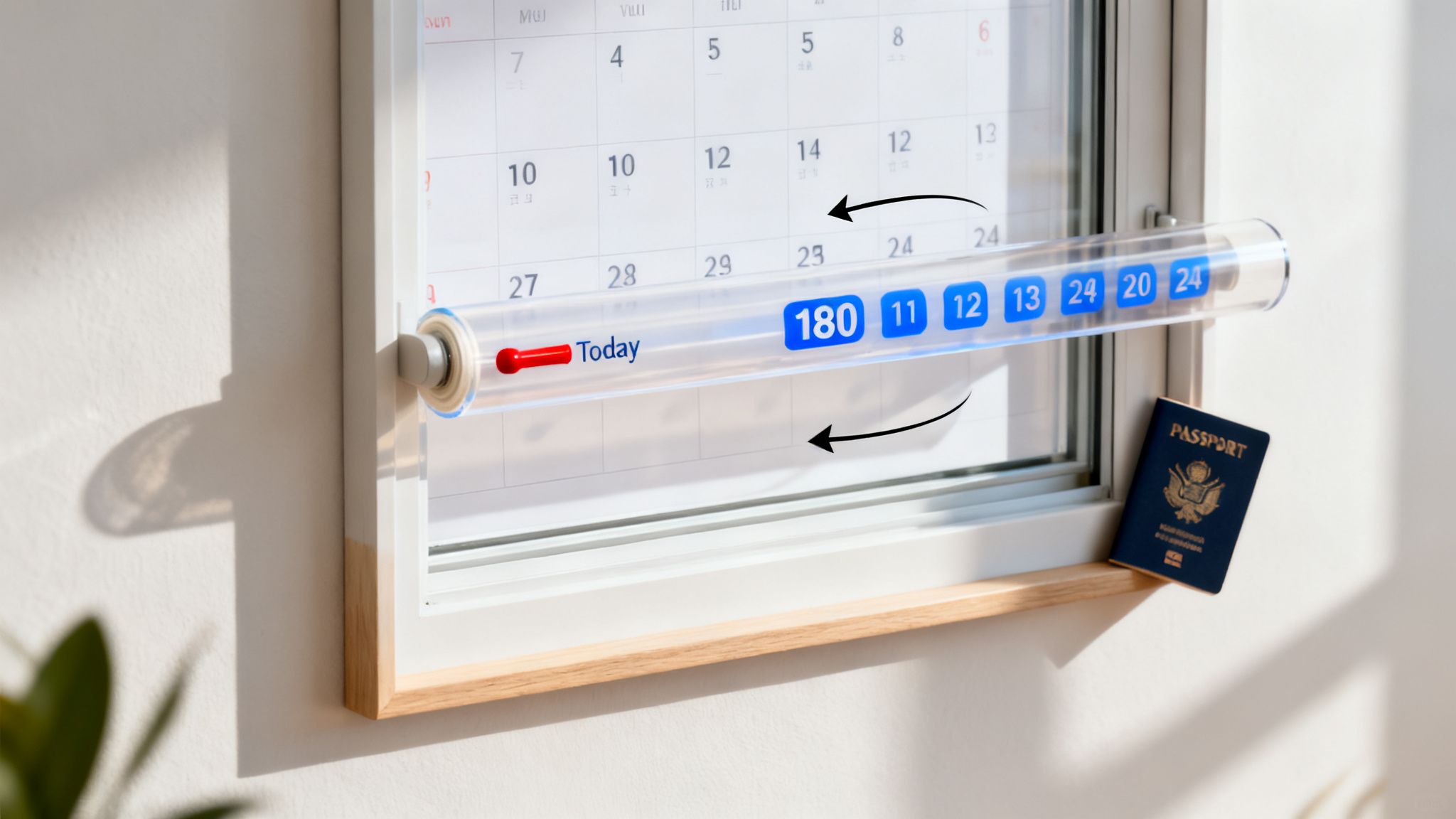
Let's clear up the biggest point of confusion with the Schengen 90/180 rule: the "rolling 180-day period." This isn't a fixed six-month block of time that resets on a specific date. It's much more fluid than that.
Think of it as a moving window that always looks backward from today. To figure out if you're allowed to enter the Schengen Area, you have to look at the last 180 days and count every single day you were physically present in the zone during that time. If your total is under 90, you're good to go.
A Digital Nomad Scenario in Portugal and Greece
Let’s walk through a real-world example. Imagine Alex, a digital nomad, who spent the winter working from Europe.
Here's his recent travel history:
- Spent 60 days in Portugal.
- Left for a 30-day trip to Morocco (which is outside the Schengen Area).
- Flew to Greece and stayed for another 30 days.
Now, Alex wants to fly to Italy for a new project. To see if he can, he has to look back over the last 180 days. His time in Portugal (60) and Greece (30) adds up to exactly 90 days. He’s maxed out. He can't re-enter until some of those first days he spent in Portugal are more than 180 days in the past, effectively "falling off" the back of the window.
How DaysAround Can Help
For anyone juggling a complex itinerary like Alex's, this is where the DaysAround iOS App becomes a lifesaver. It automatically generates a countries visited map just from your phone's photos, creating a visual and accurate travel history. This private country counter takes the guesswork out of the equation, so you don't have to do these tedious calculations yourself.
Understanding the Key Rules
This backward-looking calculation is the heart of the rule, but a few other details are just as important to avoid an accidental overstay. Honestly, getting these small things wrong is where most travelers get into trouble.
- Entry and Exit Days Count: The day you arrive and the day you leave both count as full days.
- It's a Cumulative Total: The 90-day limit is for the entire Schengen zone, not per country.
- The Look-Back is Constant: For every day you're inside the zone, that 180-day look-back period inches forward one day with you.
The core principle is simple: on any given day, your total time inside the Schengen Area over the preceding 180 days cannot exceed 90. This constant shift is what makes trying to track it on a calendar so frustrating and prone to error.
With the post-pandemic travel boom, border agents are paying closer attention. In 2024 alone, global short-stay visa issuances hit 9.7 million—a 14.1% jump from the previous year. For the growing number of nomads and long-term travelers, this just underscores the need to track your days meticulously. You can dig into more of these European travel industry trends on Insurte.com.
Using a Schengen Calculator for Trip Planning
Trying to calculate your Schengen days on a calendar is a recipe for a headache. The 90/180 rule's "rolling" nature can be tricky, and a simple miscalculation can lead to serious problems. This is where a dedicated Schengen calculator comes in—it does the heavy lifting for you. These tools are designed to apply the rule correctly, giving you a clear, immediate answer so you can book your travels without that nagging worry of an overstay.
First thing's first: you need your travel history. Dig up the exact entry and exit dates for every trip you've taken to any of the 29 Schengen countries over the past six months. Don't gloss over the short trips. Even a quick weekend in Paris or a single-day layover in Amsterdam counts toward your total.

How to Use an Online Calculator
With your travel dates in hand, using an online tool is a breeze. Our free Schengen Zone Calculator is built for these quick, no-fuss checks. Just punch in your dates, and the calculator instantly gives you a summary of your remaining days. More importantly, it will flag any potential overstays in red, making it impossible to miss. The results are crystal clear: you'll see how many days you've used, how many you have left, and the earliest date you can legally re-enter the zone if you’ve maxed out your 90 days.
How DaysAround Can Help
For frequent travelers, manually digging through old flight confirmations and passport stamps to find every single date is a real chore. This is where an automated solution really shines.
The DaysAround iOS App cuts out the manual work entirely. Instead of you hunting down dates, the app handles it for you.
- Automatic Travel History: The app securely scans the metadata of photos on your device to build a complete and accurate travel timeline. It detects border crossings and logs the dates automatically.
- Privacy-First Design: Everything happens on your iPhone. Your data never goes to the cloud, and there's no GPS tracking involved. Your travel history stays completely private, period.
- Always-On Schengen Tracker: Think of it as a persistent Schengen 90/180 tracker. It keeps a running tally, so you always know your status without ever having to run another manual calculation.
For anyone who values their time and their privacy, the DaysAround app is a game-changer. It turns the stressful task of staying compliant into an effortless background process, letting you focus on what matters—your travels.
A Schengen calculator isn't just for looking back; it's one of the best tools for planning ahead. Whether you use a quick online tool for a one-off check or the automated DaysAround app for continuous tracking, you can navigate the 90/180 rule with total peace of mind.
Common Mistakes and Tricky Scenarios That Catch Travelers Out
Even the most experienced globetrotters can get tripped up by the Schengen 90/180 rule. Little oversights have a nasty habit of snowballing, turning what should be a straightforward trip into a tangled mess of red tape. Knowing the common pitfalls is half the battle won, helping you keep your European adventures on track.
One of the easiest mistakes to make is forgetting that your entry and exit days both count as full days. It doesn't matter if you land at 11 PM or cross a border a minute before midnight—each of those counts as one full day against your 90-day limit. That small detail alone can easily lead to an accidental overstay.
Another classic blunder is misunderstanding the "rolling" window. Many people assume it's a fixed six-month block that resets on a specific date. As we've covered, it's a constant 180-day look-back from today. This gets especially confusing if you’ve taken multiple short trips, which can burn through your allowance faster than you think.
The Digital Nomad Dilemma and "Visa Runs"
For digital nomads trying to spend as much time in Europe as possible, "visa runs" are a popular tactic. The strategy involves popping over to a non-Schengen country—think the UK, Albania, or Morocco—to let the 180-day clock tick forward and "erase" older days from the count. While this is a perfectly legitimate approach, it demands flawless planning.
- Forgetting a quick trip: It's surprisingly easy to forget a weekend trip you took a few months back.
- Guessing your re-entry date: Miscalculating when you're allowed back in can get you turned away at the border.
How DaysAround Can Help
This is precisely where the DaysAround iOS App comes in. It takes the guesswork and human error out of the equation. The app can automatically create a 'where have i been map' on your device using your photos, building an accurate country counter so no trip gets missed. It gives you the confidence to plan complex itineraries and visa runs without sweating the details. Think of it as your personal Schengen 90/180 tracker, always up-to-date and on your side.
The consequences of an overstay are no joke. It's not just a slap on the wrist with a fine; it can seriously impact your ability to travel for years to come. Accurate tracking isn't just a recommendation—it's essential for any serious traveler.
The numbers don't lie. In 2024, the global Schengen visa rejection rate stood at 14.8% across 11.7 million applications. You can discover more insights about these rejection rates on hellosafe.com. Using a trusted visa calculator schengen like our free Schengen Zone Calculator for initial planning, and then the automated DaysAround app to track your stays in real-time, is the smartest way to protect yourself from these common but costly mistakes.
Why DaysAround is the Only Travel Tracker You'll Need
A one-off Schengen calculator is fine for a quick check, but for anyone who travels frequently, you need something more robust. This is where the DaysAround iOS App really shines. It’s designed as a complete, private, and automated solution for tracking your days, but what sets it apart is its hardcore commitment to your privacy.
Here’s the deal: the app does everything locally on your phone. No user accounts. No cloud sync. And absolutely zero GPS tracking. Your travel data never leaves your device, period. This privacy-first design works hand-in-hand with some clever automation. The app can build an accurate travel timeline simply by using the location data from your photos, which means you can ditch the tedious manual spreadsheets. It keeps your records precise and up-to-date, turning your photo library into a personal countries visited map filled with your own memories.

More Than Just a Schengen Counter
While it’s an excellent Schengen 90/180 tracker, DaysAround is built to be a true travel companion. It tackles several other headaches that come with a life on the move, making it an essential tool for any serious traveler.
- Tax Residency Tracking: For digital nomads and expats, keeping track of your days in each country is a non-negotiable for tax purposes. DaysAround provides the documentation you need to prove your tax residency without a hassle.
- Works Completely Offline: Your timeline and calculations are always available, even when you’re on a long-haul flight with spotty Wi-Fi.
- Zero Friction: There's no sign-up process. Just download the app and start using it. It’s designed to be simple and intuitive.
How DaysAround Can Help
DaysAround provides a comprehensive solution for modern travelers. The decision to keep all processing on your device was intentional—it gives you absolute control over your information. You get all the convenience of an automated country counter without having to trade away your privacy. With DaysAround, your "where have I been map" is for your eyes only.
DaysAround gives you ownership of your travel story. It provides the confidence and clarity to navigate complex visa rules, all while keeping your personal data exactly where it belongs—in your hands.
The need for reliable tracking tools has never been greater. In 2024, Schengen countries processed a massive 11,716,723 visa applications, which is a 13.45% jump from the year before. You can read more about these Schengen visa statistics on atlys.com. This surge makes free tools like the DaysAround Schengen Zone Calculator and the comprehensive DaysAround iOS App indispensable for staying compliant.
Frequently Asked Questions (FAQ)
Is the 90/180 rule per country or for the whole Schengen area?
The rule applies to the entire Schengen Area as a single territory. Your 90 days are a cumulative total across all 29 member countries, not a separate allowance for each one. The DaysAround iOS App excels here by acting as a single country counter for the entire zone.
What exactly is a "rolling" 180-day period?
A "rolling" period is a moving window that always looks back exactly 180 days from today (or any future date you choose). Every day, the window shifts forward one day. A Schengen 90/180 tracker like DaysAround automates this complex calculation.
What are the consequences of overstaying my 90 days?
Overstaying can lead to serious penalties, including hefty fines, deportation (at your own expense), an entry ban for several years, and a negative mark in the Schengen Information System (SIS), which can complicate future visa applications.
Do my entry and exit days count towards the 90-day total?
Yes. Both the day you arrive in the Schengen Area and the day you leave are counted as full days, regardless of the time of your arrival or departure. This is a common mistake that a good Schengen calculator helps you avoid.
How does the DaysAround app track my travels without GPS?
The app uses the location metadata embedded in the photos on your device. It analyzes this data locally on your phone to detect when you've crossed a border and builds your travel timeline. Your location is never tracked in real-time.
Is my travel data safe and private with the DaysAround app?
Absolutely. DaysAround is built with a privacy-first philosophy. All data processing happens on your device. There are no user accounts, no cloud sync, and your travel history never leaves your phone.
Can I use DaysAround for more than just Schengen tracking?
Yes. The app is a powerful tool for any global traveler. It's especially useful as a tax residency tracker, helping you monitor your days in different countries to meet fiscal requirements. It also serves as a general travel history app to create a personal map of your journeys.
Do I need an internet connection for DaysAround to work?
No. The core features, including your travel timeline and day calculations, work completely offline. This makes it a reliable tool even when you have no connectivity.
Sources
- European Commission: Short-stay Visa Calculator
- Insurte: Europe Travel & Tourism Industry and Schengen Area News, Stats & Trends 2024
- Atlys: Schengen Visa Statistics 2024