 ZeroCrew
Flags Tax
Know where you stand on tax, everywhere.
Flags Tax counts the days you spend in each country and measures them against the 183-day rule and each country's own threshold. It rebuilds your travel history from the dates and places your photos already store, on your iPhone, and warns you before you cross a line.
iPhone, iOS 18 or later



Features
You ask: Hey Siri, which country am I tax resident in?

The app answers: You're still in Spain, but the UK is approaching. You've spent 110 days in the UK this year.
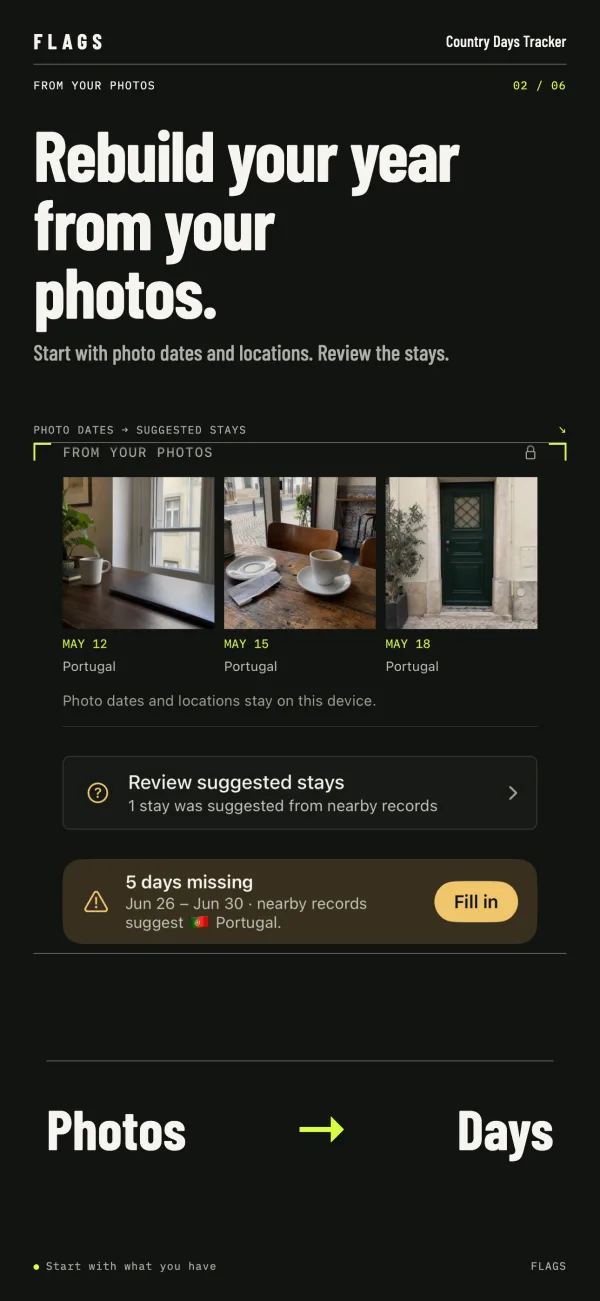
Your year, rebuilt from your photos
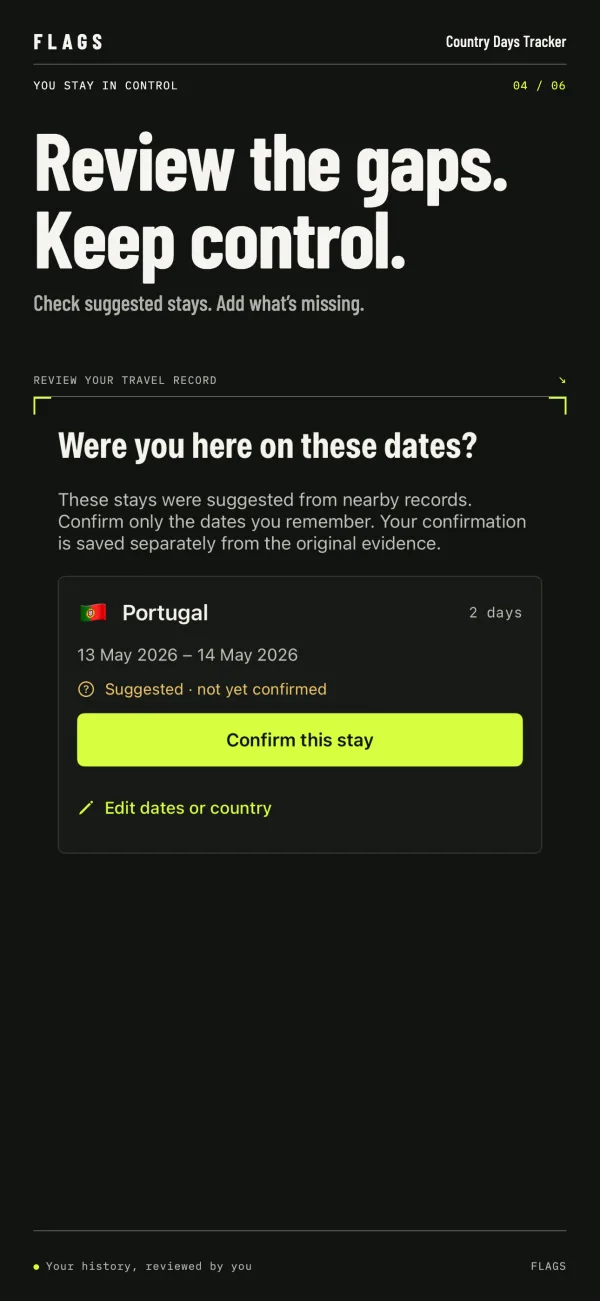
Flags Tax reads the date and place your photos store and matches them with maps built into the app. You confirm each trip in two taps, and nothing is uploaded.
One status for every place you watch
Every jurisdiction you watch is ranked by risk, with a clear verdict: resident, not resident, approaching, over, or review. Each one keeps its own tax year.
More than a day count
Mark where your home, family, or work is. In most countries those ties can make you resident regardless of days, and the UK's Statutory Residence Test uses them to lower your day limit.
A warning before you cross a line
Flags Tax spots a place you spend too long in and starts watching it. A home-screen widget and an optional weekly check-in keep the count in view.
Evidence when it matters
Export every recorded day in one country, with the evidence behind each day, as a PDF and a CSV. A one-page briefing starts the conversation with your tax advisor.
Questions
Does Flags Tax track my location?
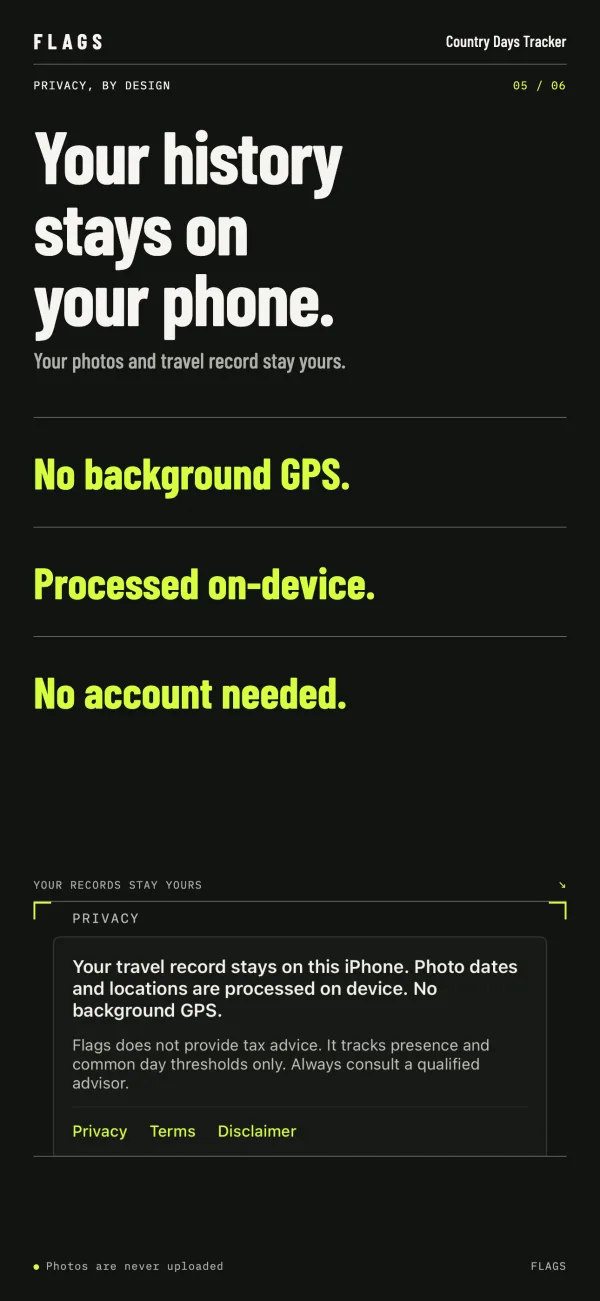
No. It never asks for location permission and never tracks you in the background. It reads the date and place your photos already store, and works out the country on your iPhone.
Which countries does it cover?
About 239 countries, plus US states, Canadian provinces, and Swiss cantons. Each jurisdiction keeps its own tax year, such as April 6 in the UK, April 1 in India, and July 1 in Australia.
A trip is missing. What do I do?
Flags Tax spots the gap and suggests where you were. Confirm the suggestion, or add the stay by hand.
Is this tax advice?
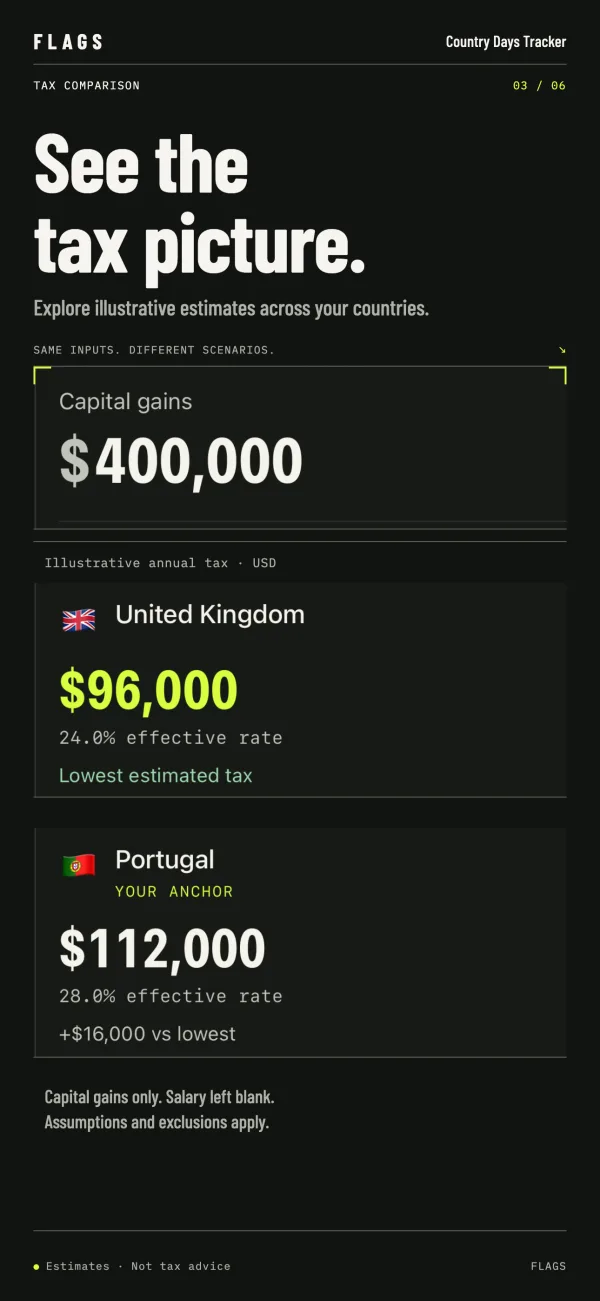
No. Flags Tax is an early-warning tool, and its tax estimates are indicative. It keeps complex rules simple on purpose. Confirm your position with a qualified tax professional before you act on it.
Where is my data stored?
On your iPhone, and nowhere else. There's no account and no sync. If you delete the app, your data goes with it.
Guides
- Flag theory & the perpetual traveler
What flag theory and the perpetual-traveler (PT) idea mean — the five flags, where the idea came from, who discusses it, and the day-counting it depends on in practice.
- How should I track days for tax residency?
A practical way to keep a day record for tax-residency questions while recognising that a day count alone is not a tax conclusion.
- What is flag theory? The five flags, explained
Flag theory means placing the parts of your life — citizenship, residency, business, money and lifestyle — in different countries chosen for where you're treated best. Here are the five flags, in plain English.
- What is the US substantial presence test?
The IRS test uses at least 31 current-year days and a weighted 183-day total across three years — here is how the weighting works, with a worked example and the exceptions that change the result.
- How does the UK Statutory Residence Test work?
The UK Statutory Residence Test uses automatic overseas and UK tests, then a sufficient-ties test where relevant.
- What is a perpetual traveler (PT)?
A perpetual traveler keeps no single fixed tax home, spending limited time in each country so no one of them claims them as resident. What the idea really involves — and the day-counting it depends on.
- How do digital nomads handle taxes?
Digital nomads don't escape tax by moving — they manage it by tracking days and ties in every country. How nomad tax actually works, and the records it depends on.
- What is the 183-day rule for tax residency?
Why 183 days is a common threshold, not a universal tax-residency answer, and why records of days and ties matter.
Tools
- Substantial presence test calculator
Enter your US days for three years and see the weighted 183-day math worked out step by step, with exempt years for students and teachers. Everything runs in your browser.
- UK Statutory Residence Test calculator
Run the automatic overseas tests, the automatic UK tests, and the sufficient ties test on one page. Each tie you tick moves your day ceiling as you go.
- FEIE physical presence test calculator
Pick a 12-month window, add your US trips, and see whether you reach 330 full days abroad for the Foreign Earned Income Exclusion. The calculator also finds the window that gives you the most full days.
More from Flags
 Flags Schengen
Stay inside the Schengen 90/180 rule. See the days you've used, the days you have left, and the day you need to leave.
 Flags Map
Your countries-visited map, filled in from the dates and places your photos already store.
Flags Tax on your iPhone
Know where you stand on tax, in every country.