
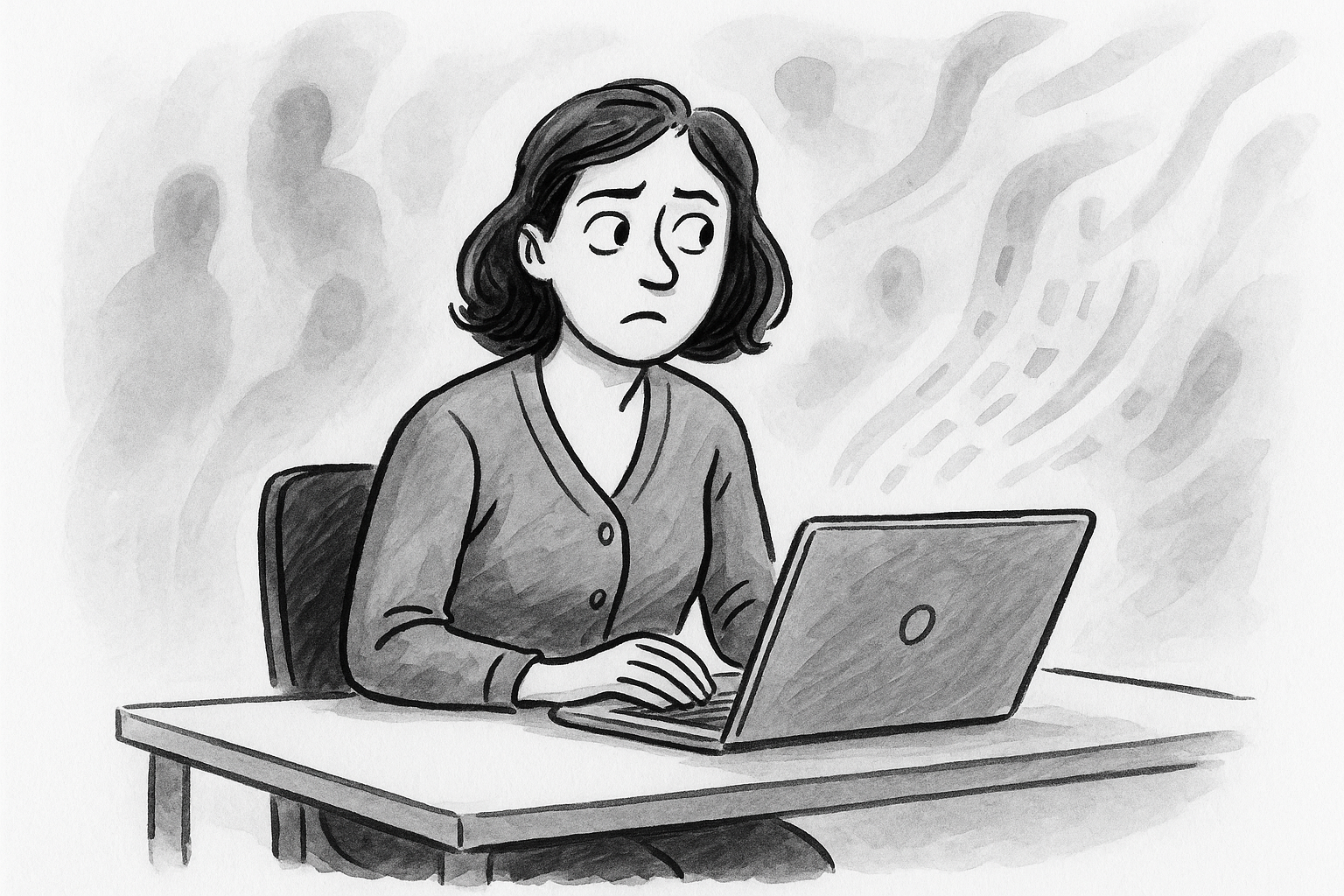
The Privacy Risks Hiding in Your Accountability Coach App (And How to Stay Accountable Without Leaking Strategy)
April 12, 2026
Most accountability coach apps help you follow through. But the moment you paste churn notes, a customer name, or runway math into a check-in, you've created a business risk.
The best apps for privacy do three things: they define what happens to your data, they limit who can access it, and they let you leave cleanly.
FocusNinja is built around a different idea. It's like an accountability coach for your week. You stay accountable by logging commitments and wins, not your entire strategy.
The hidden cost of "just logging it"
A week is a unit of execution. Drift kills weeks. So founders start journaling daily to stay on track.
Here's what most founders miss: check-ins capture your most sensitive moments.
- A churn spike. You paste the angry email.
- A pricing change. You write the exact numbers.
- A partnership issue. You add names.
- A security incident. You document the timeline.
Now that content flows through analytics tools, crash reporting, email providers, cloud hosting, and AI providers. Your privacy surface area gets bigger than you think.
FocusNinja reduces how much sensitive text you need to store. The loop is simple: Morning Anchor. Midweek Pulse. Weekly Review. Pick one thing. Track wins. Get a weekly verdict.
The 3 privacy buckets founders must separate
Most apps talk about "data" like it's one bucket. For founders, it's three.
1) Journal text (highest leak risk)
This is where founders accidentally store:
- Strategy and positioning notes
- Pricing tests and upcoming changes
- Hiring and HR conflict notes
- Partner conflict or investor sensitivity
- Customer names, emails, and incident writeups
Journal text is dangerous because it's unstructured. Easy to paste something you'll regret later.
How FocusNinja reduces this risk: our coaching is driven by your One Thing, your definition of done, and wins logged. Keep the messy thinking in your private vault. Log only what the coach needs.
2) Business metrics (small numbers, big consequences)
Founders often store:
- MRR/ARR, churn, conversion rate
- Pipeline, win rate, ad spend
- Runway, burn, payroll timing
- CAC/LTV assumptions
Metrics are sensitive because a single screenshot can reveal momentum, weakness, or negotiation leverage.
How FocusNinja handles this: accountability doesn't require exact numbers every day. If your goal is "ship onboarding v2," the weekly truth is whether it shipped. Metrics can live in your spreadsheet. FocusNinja tracks wins and outcomes without raw financial disclosure.
3) AI usage (training vs inference)
If an app has AI coaching, you must separate:
- Inference: the model reads your entry to respond
- Training: your data improves the model later
- "Quality and safety": broad language that can still mean retention and review
This is where founders get surprised. "We don't sell your data" doesn't answer "is my content used to train models?"
FocusNinja principle: you should get strong accountability without dumping sensitive context into AI prompts. Log wins. The coach uses wins as evidence.
The privacy surface area founders forget
Founders evaluate the app. They forget the app's ecosystem.
Data flows you should assume exist
- Product analytics (Amplitude, Mixpanel, PostHog)
- Crash reporting (Sentry)
- Email and SMS delivery (SendGrid, Postmark, Twilio)
- Cloud hosting and storage (AWS, GCP)
- AI providers (model APIs)
Even if the app doesn't "share your journal," it may share event metadata like feature usage, timestamps, and device info.
Support access is a real risk
Many products state: "We may access your data to troubleshoot."
The questions are:
- Is access permissioned and time-bound?
- Is access logged and audited?
- Can you disable support access?
FocusNinja pushes a workflow that stays effective when you keep sensitive attachments, customer identifiers, and long incident writeups out of the accountability layer.
The founder-risk rubric
This is the simplest way to compare accountability coach apps.
What "good" looks like
| Category | What to look for | Red flags |
|---|---|---|
| Data ownership | Clear statement that you own your content | Vague "we may use content to improve services" |
| Deletion | Defined deletion for content, backups, logs | "Delete account" with no timeline |
| Retention | Backup retention window stated (30-90 days) | No mention of backups or logs |
| AI training | Explicit "not used for training" or clear opt-out | "May use to improve AI features" |
| Sub-processors | Public list + purpose | No list, or list hidden |
| Support access | Audited, permissioned access policy | "Employees may access" with no constraints |
| Export | Full export, machine-readable (CSV/JSON) | PDF-only or "export on request" |
FocusNinja's stance: if your accountability system requires you to paste sensitive strategy every day, the system is flawed. The best execution system keeps the accountability signal high and the sensitive disclosure low.
The exact questions to ask before you commit
Copy and paste this list into sales chat or email. If they can't answer directly, don't log sensitive content.
AI and model usage
- Is my content used to train AI models? Is training opt-in or opt-out?
- If you use a third-party AI provider, do they train on my data by default?
- How long do you retain prompts and AI outputs?
Retention and deletion
- If I delete content, is it deleted from backups? How long do backups persist?
- What is the difference between deleting content, deleting an account, and deactivating?
- Do you retain logs or analytics events after deletion? For how long?
Access and sub-processors
- Can employees or contractors access my notes? Is access logged and restricted?
- Do you publish a list of sub-processors and their purpose?
- Do you share any data with advertisers or data brokers?
Portability
- Can I export everything anytime in a machine-readable format (CSV/JSON)?
- Does export include history, tags, metrics, and attachments?
Team controls
- Do you support MFA, role-based access, and audit logs?
- Can I separate workspaces so contractors can't see founder notes?
FocusNinja's product philosophy aligns with these questions: you shouldn't need to "trust vibes." You should have clear defaults, clear controls, and the ability to leave.
What not to log: Green, Yellow, Red
If you want accountability without leaking strategy, you need content rules.
Green (safe-ish to log)
- Daily commitment: "Ship onboarding email v1"
- Time block plan: "2 focus sessions on sales page copy"
- Win logs: "Published docs page. Link stored privately."
- Generic blockers: "Waiting on vendor response"
This is FocusNinja's sweet spot. Pick one thing. Track wins. Get a weekly verdict.
Yellow (log only if you trust the tool)
- Funnel totals and conversion rates
- Roadmap milestones and timelines
- Pipeline totals by stage
- Competitor notes
How to sanitize:
- Use ranges: "MRR in the 20k to 30k band"
- Use codenames: "Customer A"
- Avoid attaching raw spreadsheets
Red (avoid logging unless self-hosted)
- Customer names, emails, phone numbers
- Credentials, API keys, tokens, private URLs
- Security incidents and forensic timelines
- Legal disputes, acquisition talks, investor negotiation details
- Unreleased pricing changes with exact numbers
- HR conflict notes with identifying details
FocusNinja rule: keep Red in your own vault. Log the commitment and the outcome in FocusNinja. Example: "Resolve incident postmortem draft. Proof: stored in internal drive."
A privacy-first way to stay accountable
Accountability doesn't require full context. It requires clear commitments, proof, and a cadence.
The privacy-first check-in format
Use this for Morning Anchor, Midweek Pulse, and Weekly Review:
- What I will ship: deliverable, not effort
- By when: date and time
- Proof: link or screenshot reference (can be private)
- Blocker: sanitized, no names
Example:
- Ship: "Checkout bugfix and deploy"
- By when: "Thu 4pm"
- Proof: "Deploy tag v1.8.3"
- Blocker: "Need repro from support. No customer details in this log."
This maps directly to how FocusNinja holds you accountable:
- Morning Anchor sets the day aligned to your One Thing
- Midweek Pulse catches drift early
- Weekly Review forces a verdict using wins logged as evidence
Why this works better than journaling everything
Founders drift when the week has no single truth.
FocusNinja creates that truth with:
- One outcome for the week
- Wins logged (evidence)
- A weekly verdict
You stay accountable without creating a sensitive data dump.
Decision rule: choose the privacy posture that matches your stage
If you're solo
Prioritize:
- Exportability (CSV/JSON)
- Clear deletion and backup retention language
- Minimal-data workflow
FocusNinja is strong here because the system works with short, sanitized logs and evidence-based wins.
If you need AI coaching
Prioritize:
- Explicit training policy and control
- Retention clarity for prompts and outputs
- Sub-processor transparency
FocusNinja's approach keeps AI coaching grounded in your intentions and wins. You don't need to paste sensitive strategy for the AI to help.
If you have a team
Prioritize:
- Roles and permissions
- Audit logs
- MFA and SSO (if available)
- Workspace separation
Then enforce Red and Yellow rules. Most leaks happen through internal sharing defaults.
FAQ
Are accountability apps reading my journal entries?
If you type them into the product, the product stores them. Employees may access content for support unless access is explicitly restricted and audited. If the app offers AI features, your content may be sent to an AI provider for inference.
If an app has AI coaching, does that mean my entries train the model?
Not automatically. Training depends on the vendor policy and the AI provider contract. You want an explicit statement that your content is not used for training by default, or a clear opt-out.
What's the difference between "we don't sell your data" and "we don't use it"?
"We don't sell" usually means no data broker or ad sales. It doesn't answer whether they use content for product improvement, analytics, support, or AI training. Ask about each use separately.
What happens to my data when I cancel?
Many apps retain data for a period in backups and logs even after cancellation. "Cancel" often only stops billing. You need the retention window for backups and logs, plus a definition of what deletion covers.
Do I need end-to-end encryption for founder check-ins?
If you plan to store Red-tier content like credentials, customer identifiers, legal notes, or incident timelines, you shouldn't store it in typical accountability apps. End-to-end encryption is rare in this category. A better pattern is to avoid logging Red-tier content at all.
How do I keep accountability strong without sharing sensitive context?
Use outcome-based commitments and proof. FocusNinja's loop works with: One Thing for the week, daily anchoring, midweek correction, and a weekly verdict based on wins logged. You don't need to paste the whole story.
What's the minimum info needed for accountability to work?
A deliverable, a deadline, and evidence. FocusNinja measures progress by wins logged. Busy isn't progress. Shipped is progress.