
5 Ways Founders Turn Accountability Apps Into Productivity Theatre
April 16, 2026
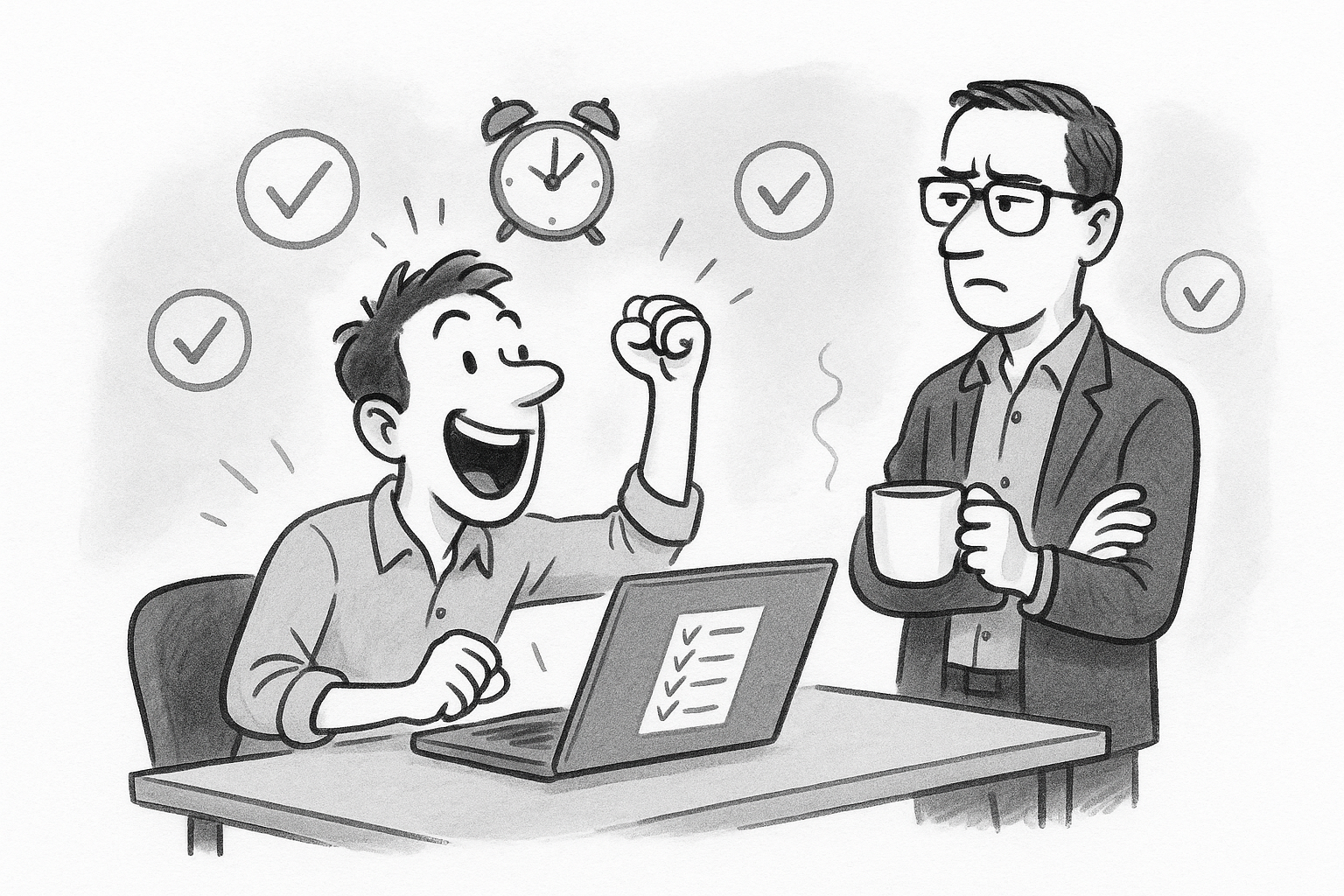
Productivity theatre is when your accountability app shows tons of activity but your business shows zero shipped work by Friday.
The biggest founder mistake? Using apps that reward engagement instead of throughput. Check-ins, streaks, "deep work" minutes — all activity. None of it ships.
FocusNinja treats a week as the unit of execution. Drift kills weeks. If your tool cannot point to a shipped artifact by Friday, it's not accountability. It's activity tracking.
It's like an accountability coach for your week.
What productivity theatre looks like (and why it happens)
Productivity theatre is visible effort that does not produce shipped work. For founders, "shipped work" means something a customer could see, buy, or respond to.
The trap is simple. Most apps optimize for daily taps and streaks because engagement is easy to measure. Founders need systems that produce weekly deliverables.
FocusNinja is built around a shipping loop: Morning Anchor. Midweek Pulse. Weekly Review. It keeps the app tied to outcomes, not rituals.
Shipping evidence you can verify
If you want your accountability tool to work, require evidence you can link, screenshot, or export.
- Code: merged PR link, deployed version, changelog URL
- Marketing: published landing page URL, email sent screenshot, live ad link
- Sales: outreach messages sent (CRM export), calls booked, proposals sent
- Research: customer interviews scheduled, recordings saved, summary doc
- Ops: invoice sent, onboarding doc finalized, hiring pipeline updated
In FocusNinja, these are "wins." Log wins. The coach uses wins as evidence.
Mistake 1: Tracking effort instead of evidence
Founders create theatre when they track "hours," "focus minutes," or "worked on MVP" and call it progress.
This feels productive because it produces numbers and charts. But it is not objectively checkable. You start believing the log is the work.
Why it backfires
- Effort can go up while output stays flat
- Vague logs cannot be audited — you cannot tell if you moved the business
- It rewards busywork — you can always "work more" without shipping
The swap: evidence-first logs
Use your app to collect proof of progress, not proof of effort.
Evidence-first daily check-in:
- Today's ship target: what must exist by end of day
- Win evidence: what you shipped since yesterday (link/screenshot)
- Blocker: what is stopping shipping
- Next action: the next move that unblocks shipping
In FocusNinja, this maps to the Morning Anchor plus daily wins logging. It keeps your accountability attached to artifacts, not vibes.
Mistake 2: Over-checking in (reflection as procrastination)
A common failure mode is turning the app into a status console. Multiple check-ins per day. Constant edits. Rewriting goals. Updating tags.
It looks disciplined. It is often avoidance.
Why it backfires
- Self-monitoring has a cost — the more you report, the less you build
- Frequent check-ins create micro-guilt — you start optimizing for "having something to say"
- The app becomes the task — execution gets pushed to "after I update"
The swap: one daily anchor, one weekly verdict
Founders need a simple rhythm. Start aligned in the morning. Correct drift midweek. Review on Sunday.
A good cadence for solo founders:
- Morning Anchor (daily, 2-5 minutes): pick the one move that advances the week's deliverable
- Midweek Pulse (Wednesday): decide Keep, Cut scope, or Swap
- Weekly Review (Sunday): verdict plus next week's One Thing
FocusNinja is designed for this cadence. It keeps check-ins light and forces the real work to happen outside the app.
Mistake 3: Too many goals (partial progress everywhere)
Theatre happens when your weekly plan has 5-10 goals, all labeled "important." You make progress on each. You finish none.
Founders do this because it feels responsible. It also reduces the discomfort of committing to one bet.
Why it backfires
- Goal dilution kills throughput — more goals means more context switching and fewer finishes
- No finish line crossed means no compounding. Shipping compounds. Partial progress does not.
- Priority fights show up midweek. The app does not resolve them. You drift.
The swap: one must-ship, one support goal, and a "not doing" list
A practical weekly structure:
- Must-ship deliverable (1): the artifact that makes the week a win
- Support goal (1): the one thing that makes the must-ship easier
- Not doing (3): specific exclusions that protect the must-ship
In FocusNinja, this is your Weekly Intention (One Thing) tied to your North Star. The AI coach evaluates you on wins logged against that intention, not on how many tasks you touched.
Mistake 4: "Nice-to-have" streaks that reward tiny tasks
Streaks are dangerous when the streak becomes the product.
A founder protects the streak with low-risk tasks: inbox cleanup, renaming files, reorganizing Notion, reading threads, "planning." The app praises consistency. The business gets nothing.
Why it backfires
- Loss aversion kicks in — you do trivial work to avoid breaking the streak
- The streak metric replaces the business metric — you protect the number, not the output
- It trains you to avoid hard tasks — scary work (shipping, selling) gets postponed
The swap: streaks only count when they touch the must-ship
If you use streaks at all, define them like this:
- A day counts only if you logged a win that moves the must-ship forward
- If you cannot move the must-ship, the day counts only if you did a verifiable customer action
FocusNinja's streak logic is grounded in wins, not taps. Busy isn't progress. Shipped is progress.
Mistake 5: No midweek decision point (where drift happens)
Most founders do a Monday plan and a Friday recap. They drift on Wednesday and Thursday when reality collides with the plan.
Without a forced midweek decision, your app becomes theatre. You keep reporting against an outdated plan until the week is gone.
Why it backfires
- Plans die quietly midweek — you do not notice until Friday
- Scope expands — the must-ship becomes "finish the whole system." Nothing ships.
- Priorities change but the app has no mechanism to re-commit
The swap: Wednesday "Keep / Cut scope / Swap"
A Midweek Pulse is a decision, not a reflection.
Midweek Pulse template:
- Reality check: what is true now (time left, blockers, new fires)
- Decision: Keep same plan, Cut scope to fit the week, or Swap to higher priority
- Friday artifact: what will exist by Friday (one sentence)
- Next 2 actions: the steps that make it real
FocusNinja bakes this in as the Midweek Pulse. It catches drift early and forces a course-correct before the week is wasted.
Theatre vs shipping system scorecard
Use this table to evaluate whether your accountability app produces shipped work or just engagement.
| Area | Theatre pattern | Shipping pattern |
|---|---|---|
| What you track | Hours, focus minutes, "worked on X" | Wins with evidence (links, screenshots) |
| Check-in cadence | Many daily updates | Morning Anchor daily, Midweek Pulse, Weekly Review |
| Goal count | 5-10 weekly goals | 1 must-ship deliverable, 1 support goal |
| Streaks | Any activity counts | Only counts if it moves must-ship or customer action |
| Midweek | No decision point | Explicit Keep, Cut scope, or Swap |
If your app cannot answer "what shipped this week?" with an artifact, change how you use it or cut it.
The litmus test: does Friday have an artifact?
A week is a unit of execution. Drift kills weeks.
By Friday, you should point to at least one of these:
- A released feature or deployed change
- A published page, email, ad, or post
- Sales outreach sent and calls booked
- Customer interviews completed with notes saved
- A proposal sent, contract signed, or revenue collected
FocusNinja's Weekly Review makes this unavoidable. Pick one thing. Track wins. Get a weekly verdict: Shipped, Wasted, or Enjoyed.
How FocusNinja prevents productivity theatre
FocusNinja is not a task manager. It is a founder execution system.
- North Star and Weekly Intention keep you aligned to one outcome
- Daily wins logging prevents "worked on it" reporting
- Morning Anchor starts the day aligned
- Midweek Pulse forces a course-correct when drift starts
- Weekly Review with AI verdict creates weekly truth, not weekly vibes
If your current accountability app makes you feel productive but cannot produce a shipped artifact each week, it is not doing the job. Change the metric to evidence, reduce the check-ins, shrink the goal count, redefine streaks, and add a midweek decision point.
Or move to a system built for shipping.