
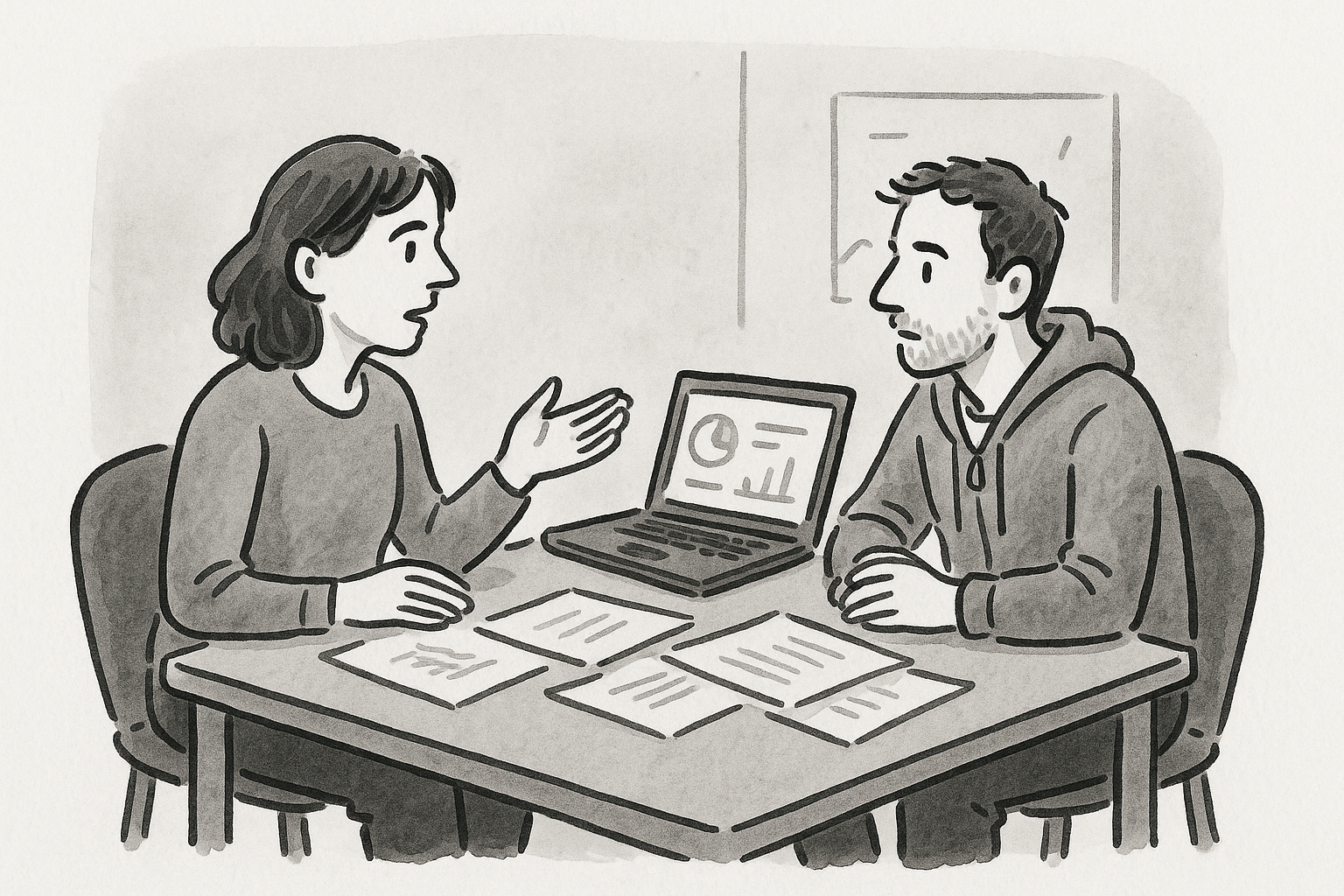
How to Choose a Founder Coach (and Avoid Expensive Productivity Theatre)
February 25, 2026
A good founder coach makes you ship more, not just think more. To avoid wasting money, choose a coach with a clear method, tight cadence, and measurable outcomes. Then run a 2 to 4 week trial where you track weekly commitments and shipped deliverables. FocusNinja is like an accountability coach for your week. It gives you the measurement layer so you can answer the only question that matters: did coaching increase shipped outcomes, or did it create productivity theatre?
The hidden cost of "expensive productivity theatre"
Productivity theatre is when your calendar is full and your notes are beautiful, but nothing meaningful ships. For founders, the cost is not the coaching fee. It is the weeks you lose.
A week is a unit of execution. Drift kills weeks.
Here is what productivity theatre looks like in coaching:
- Great conversations that end with "We'll explore that next time."
- New frameworks every call. No deadlines. No deliverables.
- Emotional relief that never turns into a concrete operating change.
- You feel "clearer," but your product, pipeline, or hiring does not move.
FocusNinja exists to stop that pattern. Pick one thing. Track wins. Get a weekly verdict.
Coaching is unregulated. Buy proof and process, not credentials
In most places, coaching is not a licensed profession. That does not mean coaching is bad. It means you cannot use credentials as your main filter.
What to buy instead:
- Proof: specific outcomes with founders like you.
- Process: a method that turns sessions into actions.
- Measurement: a way to track whether you are shipping more.
A good coach will welcome measurement. A weak coach will avoid it.
Buy the right role: coach vs advisor vs operator vs therapist vs accountability
Founders waste money when they buy the wrong category.
Coach (behavior and decisions)
A founder coach helps you:
- Make better decisions under uncertainty.
- Build an operating rhythm.
- Change behaviors that create drift (avoidance, over-scoping, context switching).
In FocusNinja terms, a coach should strengthen your loop: Morning Anchor. Midweek Pulse. Weekly Review.
Advisor or mentor (answers and pattern recognition)
An advisor helps you:
- Avoid obvious mistakes.
- Get introductions.
- Learn proven patterns for your situation.
This is useful when the main bottleneck is knowledge, not follow-through.
Consultant or fractional operator (hands-on execution)
A fractional operator helps you:
- Build a system, a funnel, a hiring process, a launch.
- Deliver work product, not just guidance.
If you need output more than insight, buy this.
Therapist (healing and clinical)
Therapy is for mental health and healing. It can indirectly improve your work. But do not buy therapy expecting shipped milestones.
Accountability system (execution consistency)
Accountability is the missing layer for many founders. It is not "motivation." It is a mechanism.
FocusNinja is an accountability system built around evidence:
- Set a North Star.
- Pick one outcome for the week.
- Log wins. The coach uses wins as evidence.
- Get a weekly verdict: Shipped. Wasted. Enjoyed.
If your main issue is drift, start here, even if you also hire a coach.
What a good founder coach looks like (checklist)
Use this checklist before you sign anything. The goal is to filter for coaches who can create behavior change that results in shipped work.
Proof of impact (specific outcomes, not vibes)
Ask for 3 specific founder outcomes the coach helped produce in the last 12 months.
Good proof sounds like:
- "They shipped MVP v1 in 5 weeks and closed 12 paid pilots."
- "They set a weekly operating cadence and hit 10 straight shipped weeks."
- "They made a pricing decision and raised conversion from 1.2% to 2.0%."
Weak proof sounds like:
- "I help founders find clarity."
- "I support leaders in alignment."
What to request:
- 2 references you can speak to for 10 minutes.
- A short written description of what changed operationally.
Operator experience (when it matters, and when it doesn't)
A coach does not need to have built your exact product. But operator experience matters when your bottleneck is operational.
Operator experience is decisive when you are:
- Designing your first GTM motion.
- Selling enterprise.
- Hiring your first manager.
- Navigating cofounder conflict while still shipping.
If you mostly need accountability and decision pressure, deep domain experience is less important than cadence and method.
A method that converts talk into action
A real coaching method produces artifacts.
Minimum viable method per session:
- Diagnose the real bottleneck.
- Choose one priority outcome.
- Commit to 1 to 3 deliverables with deadlines.
- Define the next check-in and how progress will be measured.
Artifacts a good coach uses:
- Commitment list (with dates).
- Decision log (what you decided and why).
- Weekly review format (what shipped, what didn't, what changed).
FocusNinja reinforces this by making the commitments show up daily in your Morning Anchor, and by forcing a Weekly Review verdict.
Cadence that prevents drift between calls
Weekly or biweekly calls are not enough if nothing happens between them.
Look for:
- Weekly session or weekly async check-in.
- A midweek correction mechanism (so you do not realize you drifted on Sunday).
- Clear expectations for what you deliver before the next session.
Start aligned in the morning. Correct drift midweek. Review on Sunday.
If a coach cannot describe their between-session system in one minute, you will end up paying for talking.
Measurable outcomes (leading and lagging)
Define success up front. If the coach refuses, do not buy.
Use:
- 2 to 3 leading indicators (execution quality).
- 1 to 2 lagging indicators (business impact).
Examples that work for early-stage founders:
- Leading: weekly commitment completion rate.
- Leading: number of wins logged per week (evidence of progress).
- Leading: number of "stuck days" per week.
- Lagging: shipped milestone per week (feature, landing page, outreach batch, hiring step).
- Lagging: revenue or pipeline movement.
FocusNinja tracks wins logged and shipped weeks. That gives you the neutral scoreboard many coaches never provide.
Red flags: how to spot coaching that becomes theatre
These are expensive patterns. Catch them in week 1.
Red flags in language
- Vague nouns with no operational definition: "energy," "alignment," "expansion," "next level."
- No deadlines.
- No deliverables.
Red flags in process
- The session ends without 1 to 3 concrete commitments.
- No review of last week's commitments.
- The coach does not ask, "What shipped?"
Red flags in sales and contracts
- Pressure to sign 3 to 6 months before any proof of fit.
- Won't offer references.
- Refuses to define success metrics.
- Can't say who they are not a fit for.
A good coach should be comfortable being evaluated. If they resist a 2 to 4 week measurement trial, you have your answer.
The 2 to 4 week Founder Coach Trial Scorecard (copy and use)
This is the fastest way to avoid wasting money. Run it for 2 to 4 weeks before you commit to a long retainer.
How scoring works
Score each line 0 to 2.
- 0 = did not happen.
- 1 = partially.
- 2 = clearly happened.
Target:
- 16+ out of 20 by week 2. Keep going.
- 12 to 15 out of 20. Adjust format for one more week.
- 11 or less. Stop or change the engagement.
Coach Trial Scorecard (0 to 20)
| Category | What you are checking | Score (0-2) |
|---|---|---|
| One outcome | We defined one priority outcome for the week | |
| Commitments | I left with 1 to 3 deliverables and dates | |
| Review | We reviewed last week's commitments first | |
| Blocker removal | We named one real blocker and removed or reduced it | |
| Decision velocity | I made and recorded one decision I was avoiding | |
| Execution plan | The plan fit my actual time and constraints | |
| Between-session support | There was a midweek check-in or mechanism | |
| Shipping | Something real shipped this week | |
| Evidence | We used evidence (wins, metrics) not feelings | |
| Coach behavior | They challenged me, stayed concrete, followed up |
What counts as "shipped" in early-stage work
Use this list so you do not lie to yourself:
- Product: a feature deployed, onboarding fixed, pricing page live.
- Go-to-market: 30 outbound messages sent, 10 calls booked, 5 demos run.
- Research: 10 customer interviews completed and summarized.
- Hiring: scorecard written, 10 candidates sourced, 5 screens done.
- Ops: billing set up, analytics installed, support workflow created.
"Read a book" and "thought about positioning" do not count unless they produced a decision or artifact that shipped.
How to use FocusNinja as the objective measurement layer for coaching
Most coaching fails because it has no instrument panel. FocusNinja is the instrument panel.
Step 1: Set your North Star (so coaching has a target)
In FocusNinja, define what winning means in one sentence. Examples:
- "$5k MRR from a narrow ICP."
- "Ship MVP and get 10 paid pilots."
This keeps coaching from turning into general life chat.
Step 2: Turn each coaching session into one weekly intention
After the session:
- Choose the One Thing for the week.
- Translate it into 1 to 3 deliverables.
- Put those deliverables into your week.
This is how you prevent insight from evaporating.
Step 3: Run the daily loop (Morning Anchor) so you start aligned
Every morning in FocusNinja:
- Confirm the One Thing.
- Pick the next smallest step.
- Start a focus timer tied to that intention.
Busy isn't progress. Shipped is progress.
Step 4: Use Midweek Pulse to catch drift early
Most founders drift on Tuesday and notice on Friday.
Midweek Pulse forces you to answer:
- Are you on track to ship the weekly outcome?
- If not, what will you cut, change, or commit to today?
This is the difference between coaching that feels good and coaching that compounds.
Step 5: Use Weekly Review to grade the coaching relationship
At the end of the week, FocusNinja gives a verdict:
- Shipped.
- Wasted.
- Enjoyed.
Then run your scorecard:
- Commitment completion rate.
- Wins logged.
- Shipped deliverable.
Decision rule after 2 to 4 weeks:
- If shipped weeks increase, keep the coach.
- If sessions are "good" but shipped weeks do not change, stop or change the format.
What a legit first session should include
If the first session is only "tell me about your story," you are being warmed up for a retainer.
A legit first session produces:
- One bottleneck statement (the real constraint).
- One weekly outcome.
- 1 to 3 deliverables with dates.
- A check-in plan.
- A definition of success by week 4.
In FocusNinja, that becomes your first week: One Thing, wins logged, and a Weekly Review verdict.
What should be in a coaching agreement (so you can exit cleanly)
A coaching agreement should read like a simple business contract.
Include:
- Scope: what is included and what is not.
- Cadence: weekly or biweekly sessions. Async check-ins.
- Metrics: 2 to 3 leading indicators plus shipped outcomes.
- Term: start with 4 weeks if possible.
- Exit: simple cancellation. No guilt clause. No long lock-in.
- Confidentiality: how notes are handled.
How to avoid dependence on a coach
A good coach makes you more self-sufficient over time.
Guardrails:
- Keep the measurement system independent. FocusNinja is your scoreboard, not the coach's.
- Require written commitments after each call.
- Do one "solo week" per month where you run the loop without a session.
- Review the relationship every 4 weeks using shipped outcomes.
If the coach becomes the only reason you execute, that is not coaching. That is renting momentum.
FAQ
Do I need a founder coach or just better accountability?
If you know what to do but do not do it consistently, start with accountability. If you are stuck on decisions, identity-level patterns, or leadership behaviors, add coaching. FocusNinja covers the execution loop so you can see what is actually happening week to week.
What's a fair price for founder coaching?
Pricing varies widely by coach, market, and whether it is group or 1:1. The decision rule is not "Is it expensive?" It is "Did it increase shipped weeks within 2 to 4 weeks?" Use the scorecard and FocusNinja's weekly verdict to judge value.
Should my coach have built a company in my exact domain?
Not always. Domain experience matters when you need specific operational advice. For execution consistency, method and cadence matter more. The best coaches still demand shipped evidence.
How do I verify a coach's track record without getting sold?
Ask for references and for specific before-and-after outcomes. Then run a short trial with measurement. FocusNinja gives you a neutral scoreboard so you do not rely on persuasion.
How long should I try coaching before deciding it's working?
Two to four weeks is enough to see if commitment completion and shipping increase. If nothing changes by week 4, it will not magically change in month 6.
What outcomes should I expect in 30/60/90 days?
In 30 days: a stable weekly cadence and at least 3 shipped weeks. In 60 days: faster decisions and fewer stuck days. In 90 days: measurable business movement tied to the North Star. Track it through wins logged and weekly verdicts.
What's the difference between therapy, coaching, consulting, and advising?
Therapy treats mental health. Coaching changes behavior and decisions. Consulting and fractional roles produce hands-on work product. Advising gives answers and patterns. FocusNinja is the execution system that converts any of those into weekly shipped output.
What are the warning signs I'm paying for motivation, not execution?
If you feel better after calls but do not ship more, that is motivation without mechanism. If there are no commitments, no review of last week, and no measurement, you are in theatre.
What should a coach welcome if they're legit?
Measurement, short feedback loops, and an exit option. A good coach wants to be held accountable to shipped outcomes. Pair them with FocusNinja to make that visible.