
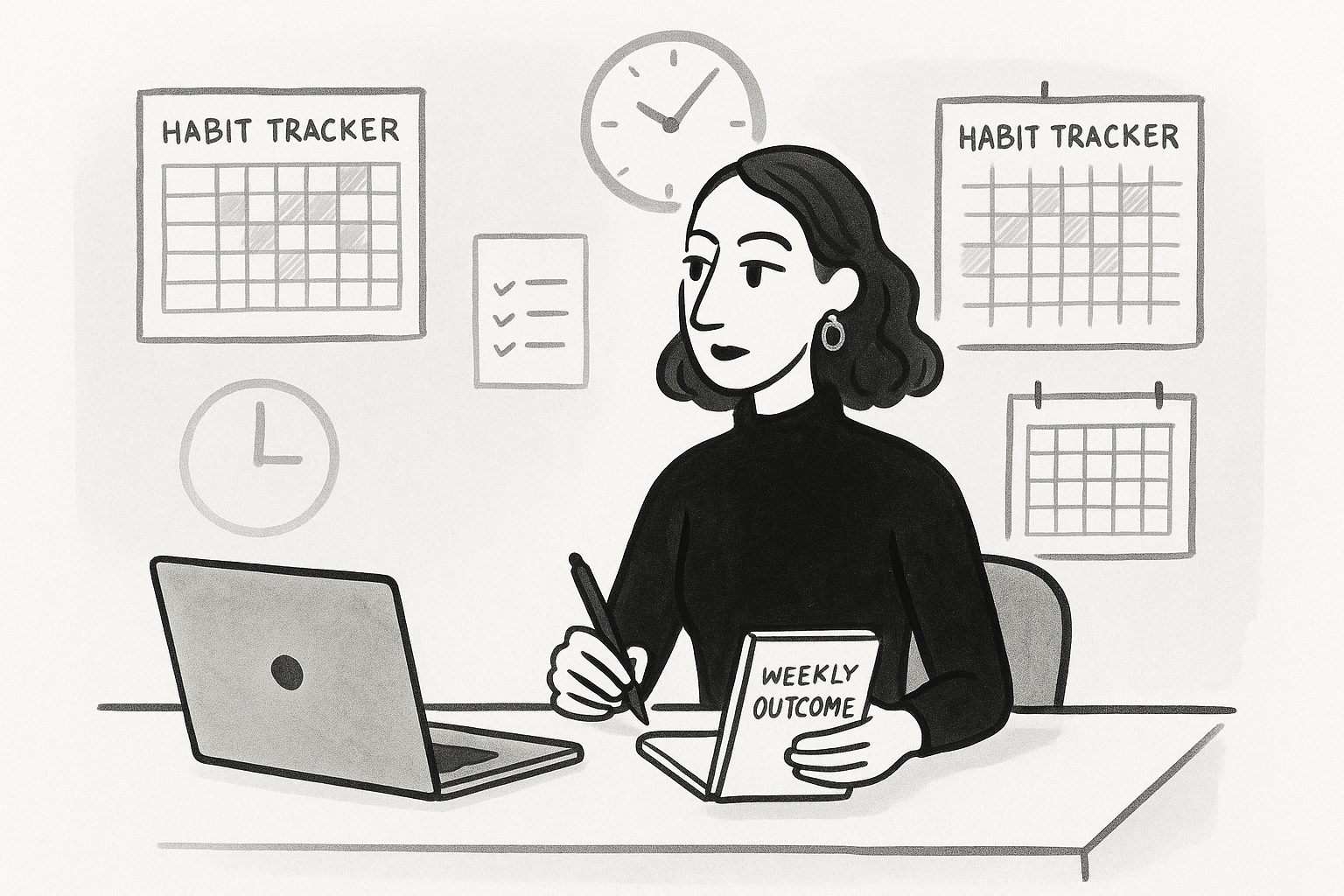
Habit Trackers Won't Save Your Startup: What Actually Stops Weekly Drift
April 9, 2026
You stop drifting week to week when your week has a clear outcome, protected time to build it, and a review that tells the truth.
Habit trackers improve consistency. Time blocking protects time. Life-in-Weeks gives strategic direction. But none of them, alone, forces a shipped week.
That's why FocusNinja exists. It's like an accountability coach for your week.
Pick one thing. Track wins. Get a weekly verdict.
Your week has no definition of done
Most founders don't have a motivation problem. They have a weekly outcome problem.
A week is a unit of execution. Drift kills weeks. If you don't define what "done" looks like by Sunday, you can work hard all week and still end with nothing you can point to.
Here's the difference:
- Busy week: Many actions. Many tabs. Few finished artifacts.
- Shipped week: One meaningful outcome finished and pushed into the world.
In FocusNinja, this becomes simple: You set your One Thing for the week, log wins as evidence, and get a weekly verdict: Shipped, Wasted, or Enjoyed.
Outcomes matter more than inputs
Most tools measure inputs:
- time spent
- habits completed
- tasks checked
Founders need outcomes:
- a landing page published
- an experiment run
- a pricing test shipped
- customer conversations completed and summarized
FocusNinja tracks what matters. You declare the week's One Thing, then log wins tied to it. The AI coach reviews your evidence and delivers a verdict.
Habit trackers: Great for consistency, weak for business direction
Habit trackers work when a behavior is repeatable, clear, and binary to measure.
They're excellent for keeping your engine running. They're not great at telling you what your startup needs next.
Where founders get trapped
The common failure mode is swapping traction for streaks.
You track meditation and hydration. You feel "disciplined." You still don't ship the pricing page, run outreach, or close the loop on the experiment.
Habit trackers reinforce identity through consistent feedback. But if the habit doesn't map to a business outcome, you're building an identity that can still drift.
The founder-safe way to use habit trackers
Use habit tracking as support, not as the scoreboard.
Track 1-2 capacity habits that keep you able to ship:
- Sleep window (in bed by 11:30)
- Workout (3x/week)
- Outreach reps (5 messages/day, only if sales is your bottleneck)
Don't track 12 habits. A founder with 12 tracked habits usually has 0 shipped outcomes.
How FocusNinja fits: Your Identity setting establishes the standard you act from. Your logged wins show whether the habit actually supports shipping.
Time blocking: Strong for execution time, weak for priority truth
Time blocking is a calendar mechanism. It answers "When will I do the work?"
It doesn't answer "Is this the right work?"
What time blocking does well
Time blocking helps when your priorities are already chosen, your tasks are concrete, and you need uninterrupted build time.
It turns intention into a scheduled commitment.
Why time blocking can still produce drift
You can time-block the wrong thing perfectly.
Common failure modes:
- Fragile schedules that collapse after one surprise call
- Calendar guilt when blocks get moved three times
- Planned time becomes the win instead of value delivered
A founder can have a beautiful calendar and still ship nothing.
The resilient version of time blocking
Use fewer blocks, tied directly to the weekly outcome.
2-3 outcome blocks per week. 1 chaos buffer block so reality doesn't destroy the plan.
Example schedule for shipping onboarding email sequence v1:
- Tue 9:00-10:30: Draft emails 1-3
- Thu 9:00-10:30: Draft emails 4-6
- Fri 9:00-10:00: Implement and send test
- Wed 4:00-5:00: Chaos buffer
How FocusNinja fits: Your Focus Timer ties sessions to your One Thing. Morning Anchor asks what you'll ship today, not what you'll attend. Midweek Pulse catches drift when the blocks slipped.
Life-in-Weeks: The strategic container that makes drift visible
A Life-in-Weeks tracker is a macro constraint. It makes one thing emotionally real: you don't have infinite weeks.
Used well, it forces tradeoffs. Used poorly, it becomes a mortality poster you admire once a month.
What Life-in-Weeks does well
For founders, Life-in-Weeks is strong at:
- Strategic awareness: "Three months passed. Did anything ship?"
- Season planning: Launch season vs recovery season vs learning season
- Tradeoff clarity: Saying yes consumes weeks
It answers "What matters in this season of my life and business?"
The failure mode: Insight without follow-through
Life-in-Weeks can show you drift without stopping it.
Founders build the grid, feel urgency, then return to the same weekly chaos because nothing changes on Monday.
The founder-safe way to use Life-in-Weeks
Use it as a strategic container in one pass:
- Label your current season ("MVP to first 10 customers")
- Define what progress means by week ("2 experiments shipped per week")
- Commit to fewer bets, not more
How FocusNinja fits: Your North Star turns the season into a weekly standard. The system forces a bridge from strategy to execution through your weekly One Thing.
What actually works: The simple stack that stops drift
If you want to stop drifting, build a stack where each layer has a job. Keep it small.
The stack (container to accountability)
- Life-in-Weeks: Strategic container. Choose the season.
- Weekly outcome: One shipped result by Sunday.
- Time blocking: 2-3 blocks that produce the outcome.
- Support habits: 1-2 habits that protect capacity.
- Accountability (FocusNinja): Daily alignment plus a weekly verdict.
FocusNinja closes the loop: Start aligned in the morning. Correct drift midweek. Review on Sunday.
Busy isn't progress. Shipped is progress.
What a good weekly outcome looks like
A weekly outcome must be visible, testable, and small enough to finish in 5-10 hours of focused work.
Examples:
- Ship onboarding email sequence v1 and send it to all new signups
- Run a pricing test with 2 tiers and email 30 leads
- Publish a landing page and launch it to 3 channels
- Record 5 customer calls, extract 10 pain points, write a one-page decision memo
- Implement one activation improvement and measure the next 50 signups
In FocusNinja, you set this as your One Thing, then log wins as evidence.
How to combine without complexity
Use one weekly note plus your calendar:
- One sentence: This week's outcome
- Three time blocks: When you'll build it
- Two support habits: What keeps you functional
- Daily wins logged in FocusNinja
If your system takes more than 15 minutes a week to maintain, it dies.
Choose the right tool based on what's broken
| Your problem | Tool that helps most | How FocusNinja helps |
|---|---|---|
| Inconsistent energy | Habit tracker (1-2 habits) | Identity + wins show whether habits support shipping |
| Consistent but scattered | Weekly outcome + time blocking | One Thing + Focus Timer tied to intention |
| Executing the wrong work | Life-in-Weeks + North Star | North Star planning plus weekly verdict reveals misalignment |
| You plan well but don't ship | Accountability layer | Morning Anchor, Midweek Pulse, Weekly Review |
The truth founders avoid
If you repeatedly don't ship, you don't need a prettier planner.
You need a weekly truth loop:
- what you said mattered
- what you actually did
- what you'll change next week
That's what FocusNinja is designed to run.
Minimal setup you can maintain for 90 days
Founders don't fail from lack of ambition. They fail from systems they can't maintain.
The minimum effective setup (15 minutes per week)
Sunday (10 minutes)
- Pick one weekly outcome (One Thing)
- Schedule 2-3 blocks for it
Daily (2 minutes)
- Morning Anchor in FocusNinja
- Log 1-3 wins tied to the outcome
Wednesday (3 minutes)
- Midweek Pulse: Are you on track or drifting?
Sunday (5-10 minutes)
- Weekly Review: Get the verdict. Decide next week.
This is what FocusNinja automates and reinforces. It behaves like an accountability coach, but it's lightweight enough for solo founders.
How to avoid guilt when you miss habits or blocks
Guilt isn't a strategy. Evidence is.
- Missed a habit? Log a win anyway.
- Missed a block? Reschedule one block, not the whole week.
- Behind by Wednesday? Midweek Pulse forces a course correction.
FocusNinja's review isn't a mood journal. It's a decision tool.
Stop tracking life. Start shipping weeks.
Habit trackers help you stay consistent. Time blocking helps you protect time. Life-in-Weeks helps you choose direction. None of them, alone, stops founder drift.
The fix is a weekly outcome plus accountability. That's the FocusNinja loop: Morning Anchor. Midweek Pulse. Weekly Review.
You pick one thing, log wins as evidence, and get a weekly verdict that keeps the week from quietly disappearing.